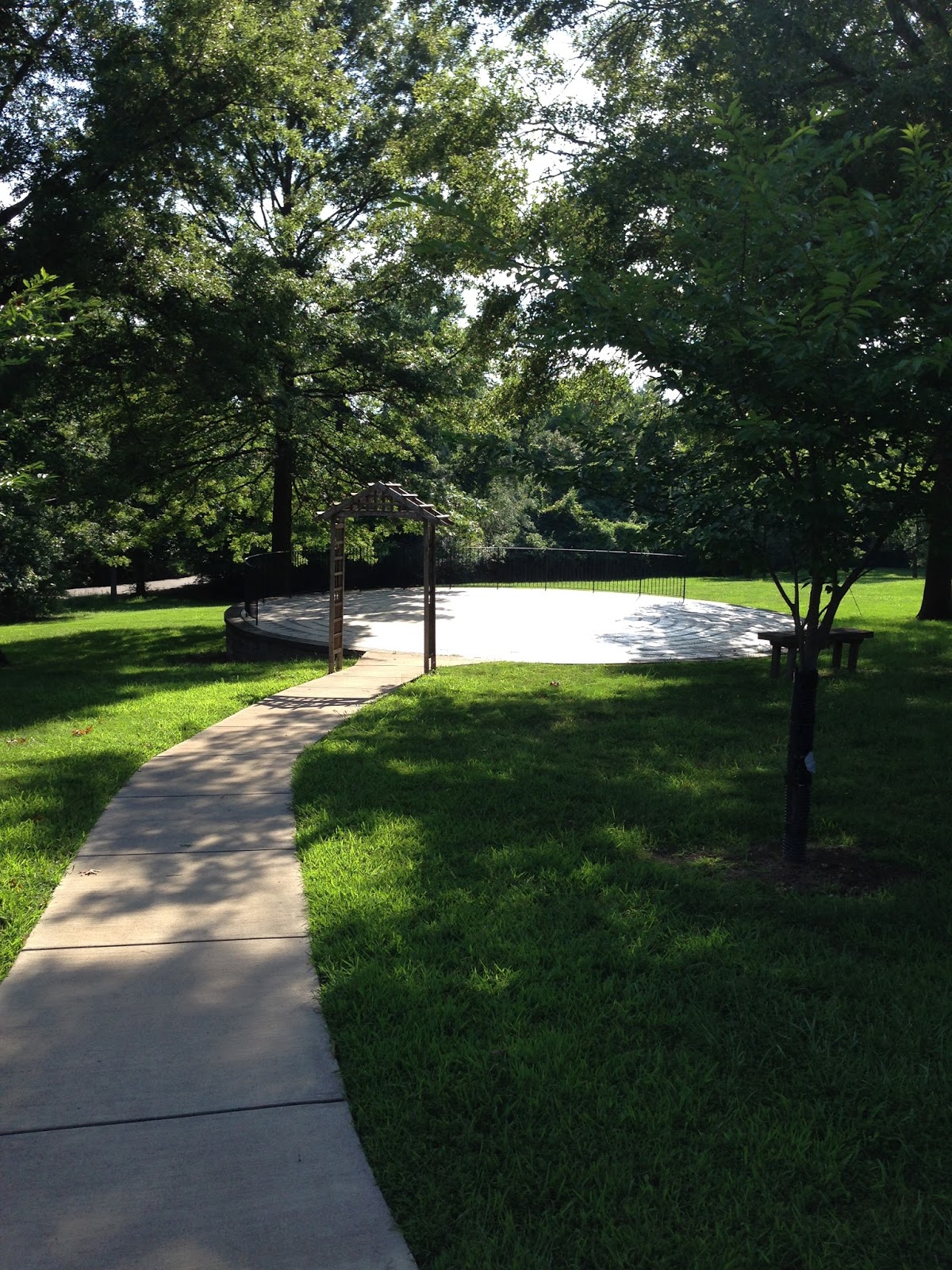
T and I chose the fourth labyrinth based on traffic patterns and distance from work. “I have a feeling it may not be particularly aesthetically pleasing,” I warned as I plugged the address into my phone.
We pulled into the parking lot and walked around the building in search of the labyrinth. My gut was right. The stones and weeds had grown together making the path hard to distinguish.
I reminded my friend about the shedding of life's worries that one does as she enters the path, the quiet reflection at the center, and then the walk out ready to take on the world again.
“This labyrinth walk may supply some metaphors not found at the other labyrinths,” I suggested before we started our walk.
I took the lead and we silently made our way as best we could through the winding path. It was comforting to pass T on occasion and I did not experience the claustraphobia of two days before. Partially because I was so focused on keeping my way on the path. We struggled to differentiate the path as we approached the center.
Once there, we smiled and looked at each other. “Wanna say a prayer for each other?” I suggested. T nodded and I asked what I could pray for. We clasped hands, bowed our heads, and I prayed. When I was finished, she began praying for me. There really isn't anything like the closeness of friends who pray together for each other. When our prayers were said, we hugged and began our journey out.
We got stuck. We couldn't unwind our way out. And so we began pulling weeds to make sense of where we were. We stood and studied the dirt, the dirt-colored stones, and the weeds.
We pulled weeds and then walked further only to get stuck again. We pulled more weeds and stood back to assess our progress. We gave it a fair chance and finally decided to call it over.
We stood outside the labyrinth and continued to talk. The best metaphor I could think of in the moment was that this grown-over path is a good reminder of how important boundaries are in life and relationships. They make interactions clear and safe. Without clear-cut boundaries, things get murky and confusing, and it's hard to know how to proceed.
Later as I was skyping with a friend about the evening's visit, she pointed out some other takeaways: I mentioned that it had been tricky getting to the center. “Julie, that's a great metaphor for the contemplative life. It IS hard getting to the center.” I love having friends that “get” this journey I'm on and who add to it.
I also explained how the weeding felt like a “pay it forward” kind of thing. “Julie, there's another great metaphor! You two were making the path easier for those who followed! I love it!” my friend reflected.
“I want to take you to the labyrinth I visited on Saturday,” I told T as we headed back to my car. “I want you to experience a really good one.” We've only visited grass covered ones when we've been together.
While this wasn't exactly the experience I had hoped for, it was fruitful and joyful nonetheless. I really do have a desire to spearhead a labyrinth project at my congregation, and this fourth labyrinth was a cautionary tale about choosing materials for a path. If we're going to go to the effort and expense to build one, we need to think about future maintenance. I am certain that this labyrinth wasn't overgrown at the beginning. I'm certain the path was clear and easier to navigate. Once the newness wore off, it became one more thing for busy people to maintain, and it fell off people's to-do lists.
I am so glad that I put these labyrinth visits on my list. It put this beautiful practice back on my radar. I have missed walking them. These visits have piqued my interest in going to the other ones throughout the region. I still want to take in the one in Chartres, France. Maybe I'll add that to another year's list. For now, #8 is complete.
Tuesday, August 4, 2015
Monday, August 3, 2015
How to Become a Confident Cook
With very few exceptions, giving a cookbook to a woman who isn't comfortable in the kitchen does not fix her problem. My aversion to cooking is legendary. Every few Christmases or birthdays for at least a decade a new cookbook would find its way into my lap. I'd smile and say thank you and say to myself, “What am I going to do with this one?”
The problem for women who don't like to cook is not a shortage of recipes from which to choose, which the cookbooks can remedy. The problem is a shortage of confidence and know-how. Most cookbooks do not supply these missing ingredients.
Making a joke about the loaf of store-bought bread or dinner rolls that the woman brings to a potluck instead of a casserole or salad is also not recommended for helping the woman feel more comfortable in the kitchen. The store-bought items are her attempt at contributing to the meal. She needs to hear that a covered dish is not the only valued way she can contribute to the community.
If you really want to help a woman build her confidence in the kitchen, invite her into yours and give her a job to do. Ask her to chop the onions and show her the technique you like to use. Ask her to stir something. Show her by your example why you feel joy when you're preparing a meal for the people you love. Demonstrate that mistakes are part of the drill and can always be corrected.
Watching Joanne Weir's PBS cooking show, Cooking Confidence, with my preschooler helped to begin changing my attitudes in the kitchen. Her kind, smiling face demonstrated how much she loved spending time in her kitchen and she was adept at teaching the episode's student the tricks of her trade. Cadence and I would lay on the couch in our living room and pick an episode from the menu on our DVR. For thirty minutes, my four-year-old and I would learn together. We would have real conversation about the ingredients she had chosen and how she was preparing them.
Cadence enjoyed it so much, we began playing “Cooking Show” when it was time to prepare a meal. We would look at the imaginary camera in our kitchen and tell our audience what we were doing. Some days we would tell them we were washing our dishes first, so that our kitchen was clean before we started our recipe. So much regular stuff could get accomplished under the spell of playing “Cooking Show.”
My daughter didn't know it, but it was her little hand taking mine that led me into our kitchen and helped build my confidence. I didn't want her to feel helpless in the kitchen like me, so I chose recipes I knew how to make and began teaching her how to make them. Raspberry muffins were our first success. When we didn't have nuts one particular Saturday morning, we substituted them with coconut and a new tradition was born.
“I'm a good cooker, aren't I, Mama?” Cadence began asking with regularity. I would smile and answer, “Absolutely.” In these moments, we were both learning cooking confidence. I have had so many cooking successes since then that it's no longer accurate to say that I don't like cooking or am not very good at it. It turns out that now I'm a good cooker too.
The problem for women who don't like to cook is not a shortage of recipes from which to choose, which the cookbooks can remedy. The problem is a shortage of confidence and know-how. Most cookbooks do not supply these missing ingredients.
Making a joke about the loaf of store-bought bread or dinner rolls that the woman brings to a potluck instead of a casserole or salad is also not recommended for helping the woman feel more comfortable in the kitchen. The store-bought items are her attempt at contributing to the meal. She needs to hear that a covered dish is not the only valued way she can contribute to the community.
If you really want to help a woman build her confidence in the kitchen, invite her into yours and give her a job to do. Ask her to chop the onions and show her the technique you like to use. Ask her to stir something. Show her by your example why you feel joy when you're preparing a meal for the people you love. Demonstrate that mistakes are part of the drill and can always be corrected.
Watching Joanne Weir's PBS cooking show, Cooking Confidence, with my preschooler helped to begin changing my attitudes in the kitchen. Her kind, smiling face demonstrated how much she loved spending time in her kitchen and she was adept at teaching the episode's student the tricks of her trade. Cadence and I would lay on the couch in our living room and pick an episode from the menu on our DVR. For thirty minutes, my four-year-old and I would learn together. We would have real conversation about the ingredients she had chosen and how she was preparing them.
Cadence enjoyed it so much, we began playing “Cooking Show” when it was time to prepare a meal. We would look at the imaginary camera in our kitchen and tell our audience what we were doing. Some days we would tell them we were washing our dishes first, so that our kitchen was clean before we started our recipe. So much regular stuff could get accomplished under the spell of playing “Cooking Show.”
My daughter didn't know it, but it was her little hand taking mine that led me into our kitchen and helped build my confidence. I didn't want her to feel helpless in the kitchen like me, so I chose recipes I knew how to make and began teaching her how to make them. Raspberry muffins were our first success. When we didn't have nuts one particular Saturday morning, we substituted them with coconut and a new tradition was born.
“I'm a good cooker, aren't I, Mama?” Cadence began asking with regularity. I would smile and answer, “Absolutely.” In these moments, we were both learning cooking confidence. I have had so many cooking successes since then that it's no longer accurate to say that I don't like cooking or am not very good at it. It turns out that now I'm a good cooker too.
Sunday, August 2, 2015
8. Visit Four New Labyrinths - #3
I pulled into the church parking lot hoping that the labyrinth directory online wasn't outdated. I spotted the sign with “Labyrinth” and an arrow and turned my car in that direction. I saw this sign and felt a catch in my throat.
Before I found my way to yoga, labyrinths had caught my attention. They are both disciplines focused on stillness in the midst of chaos, connection to something greater, and living in the present moment.
Each labyrinth I have visited is accompanied by some contextual information. I love reading what each organization that hosts the labyrinth chooses to share with visitors. I especially like what I read on this one:
“Ancient Celtic Christianity emphasized the connectedness of all things. This was symbolized by a circle in the center of the cross. One of their defining beliefs was the presence of God in creation.
They often spoke of the thin places, a place where the veil between the physical realm and the spiritual realm become so thin that we encounter the presence of God in a deeper way. A thin place is a sacred location that draws you into the life of God. It is our hope that this garden will become a thin place for you.”
I slowly approached the labyrinth grateful for my sunglasses. The late afternoon sun was shining directly on the center of the labyrinth. I set my keys on the bench nearby and began my walk.
The whole point of the pattern of the labyrinth is that you can mindlessly follow it without having to pay attention to where you are going leaving mental space for quiet reflection and meditation.
Yoga and labyrinths are also good disciplines for me because stillness of mind and body do not come easily. Both disciplines allow movement while seeking inner quiet. I had taken no more than a few paces on the path when tears began to flow. I have learned that these tears are always a sign of the Holy Spirit's presence and I welcome them. I kept weaving my way through the path. I always seem to hit a moment of panic—it's like a flash of inner claustraphobia that strikes—when I've walked deeply into the path. It always happens on my walk inward and leaves as quickly as it comes.
When I entered the center, the tears appeared again. I took a few photos as I always do to document my arrival in the center. I sat down to pray and listen, my back to the sun. I felt the heat of the sun warm my black-tee-shirted torso. I let the warmth absorb. I watched the cars buzz past on the highway that was within view of the labyrinth.
I heard two sounds: highway traffic and birdsong--a strange combination and not especially meditative. I was reminded again of what yoga has taught me that could be applied as I sat on the warm concrete. We can be at peace even with noise and chaos surrounding us. Life doesn't come with a mute button. We have to train ourselves to find quiet and stillness and peace in the midst of the noise. And so I did.
I spent a lot of my walk into the middle thinking about my life right now and how I am adjusting to having more time to myself than I have had in a long time. Suddenly these words came to mind: “Don't be afraid of being alone right now.” Deep comfort and confidence washed over me because I knew these were not my words. Because I was open and listening, I heard God share what I needed to hear. I am so grateful for being willing to be quiet and listen. I am never disappointed. I took in these words, let them resonate inside me for a few minutes and then laid down in the center and soaked up the heat of the sun's rays and warm concrete. When laying down no longer felt comfortable, I sat back up, looked around and tuned into the hum of the highway and the birds chirping again.
I stood up and began the walk back out feeling lighter than when I'd entered. I exited the labyrinth and walked to the bench where I'd set down my keys. I sat down on the bench not ready to leave. I looked around the labyrinth dreaming about how to spearhead the construction of a labyrinth on our church property. I'd spent the morning mowing, trimming, and weeding my yard. My hands were tender from pulling the tough weeds. I saw a few weeds poking out of the cracks around the labyrinth. I stood up and walked over to the first weed. I yanked it out. I plucked all of the weeds that had sprouted outside the labyrinth--my admission fee for time spent there. Something practical to do with my hands as my heart and mind prepared to leave.
I have one more labyrinth to visit before I can cross this item off my list. I'm going to visit the fourth one with a friend who has walked labyrinths with me before. I love that I introduced my daughter to labyrinths as part of my check off, and am really looking forward to my time with my friend on #4. But I am also deeply grateful for the chance to have experienced one on my own—free to stay as long as I want and to experience what I did in solitude. I indeed consider this a "thin place" and will visit it again and again.
If you're in the St. Louis area and would like to visit this labyrinth, it is located on the property of the Dayspring Baptist Church at 1001 Municipal Drive in Town and Country, Missouri.
Before I found my way to yoga, labyrinths had caught my attention. They are both disciplines focused on stillness in the midst of chaos, connection to something greater, and living in the present moment.
Each labyrinth I have visited is accompanied by some contextual information. I love reading what each organization that hosts the labyrinth chooses to share with visitors. I especially like what I read on this one:
“Ancient Celtic Christianity emphasized the connectedness of all things. This was symbolized by a circle in the center of the cross. One of their defining beliefs was the presence of God in creation.
They often spoke of the thin places, a place where the veil between the physical realm and the spiritual realm become so thin that we encounter the presence of God in a deeper way. A thin place is a sacred location that draws you into the life of God. It is our hope that this garden will become a thin place for you.”
I slowly approached the labyrinth grateful for my sunglasses. The late afternoon sun was shining directly on the center of the labyrinth. I set my keys on the bench nearby and began my walk.
The whole point of the pattern of the labyrinth is that you can mindlessly follow it without having to pay attention to where you are going leaving mental space for quiet reflection and meditation.
Yoga and labyrinths are also good disciplines for me because stillness of mind and body do not come easily. Both disciplines allow movement while seeking inner quiet. I had taken no more than a few paces on the path when tears began to flow. I have learned that these tears are always a sign of the Holy Spirit's presence and I welcome them. I kept weaving my way through the path. I always seem to hit a moment of panic—it's like a flash of inner claustraphobia that strikes—when I've walked deeply into the path. It always happens on my walk inward and leaves as quickly as it comes.
When I entered the center, the tears appeared again. I took a few photos as I always do to document my arrival in the center. I sat down to pray and listen, my back to the sun. I felt the heat of the sun warm my black-tee-shirted torso. I let the warmth absorb. I watched the cars buzz past on the highway that was within view of the labyrinth.
I heard two sounds: highway traffic and birdsong--a strange combination and not especially meditative. I was reminded again of what yoga has taught me that could be applied as I sat on the warm concrete. We can be at peace even with noise and chaos surrounding us. Life doesn't come with a mute button. We have to train ourselves to find quiet and stillness and peace in the midst of the noise. And so I did.
I spent a lot of my walk into the middle thinking about my life right now and how I am adjusting to having more time to myself than I have had in a long time. Suddenly these words came to mind: “Don't be afraid of being alone right now.” Deep comfort and confidence washed over me because I knew these were not my words. Because I was open and listening, I heard God share what I needed to hear. I am so grateful for being willing to be quiet and listen. I am never disappointed. I took in these words, let them resonate inside me for a few minutes and then laid down in the center and soaked up the heat of the sun's rays and warm concrete. When laying down no longer felt comfortable, I sat back up, looked around and tuned into the hum of the highway and the birds chirping again.
I stood up and began the walk back out feeling lighter than when I'd entered. I exited the labyrinth and walked to the bench where I'd set down my keys. I sat down on the bench not ready to leave. I looked around the labyrinth dreaming about how to spearhead the construction of a labyrinth on our church property. I'd spent the morning mowing, trimming, and weeding my yard. My hands were tender from pulling the tough weeds. I saw a few weeds poking out of the cracks around the labyrinth. I stood up and walked over to the first weed. I yanked it out. I plucked all of the weeds that had sprouted outside the labyrinth--my admission fee for time spent there. Something practical to do with my hands as my heart and mind prepared to leave.
I have one more labyrinth to visit before I can cross this item off my list. I'm going to visit the fourth one with a friend who has walked labyrinths with me before. I love that I introduced my daughter to labyrinths as part of my check off, and am really looking forward to my time with my friend on #4. But I am also deeply grateful for the chance to have experienced one on my own—free to stay as long as I want and to experience what I did in solitude. I indeed consider this a "thin place" and will visit it again and again.
If you're in the St. Louis area and would like to visit this labyrinth, it is located on the property of the Dayspring Baptist Church at 1001 Municipal Drive in Town and Country, Missouri.
Wednesday, July 29, 2015
Memories Conjured by Music - Song 1
Since I don't have a reliable sense of smell, my other senses have heightened to compensate. I hear others talk about how smells conjure memories for them. Hearing music has taken over that role for my puny sense of smell.
I'm going to spend some time reminiscing about some of the music—songs or entire albums—that evoke memories of specific times and places in my life. A different form of time travel, which seems to be a theme in my blogging these days.
The first song in my soundtrack is the guitar instrumental, St. Agnes and the Burning Train, from Sting's Soul Cages album.
He'd returned for a visit to campus. I was excited and nervous, then disappointed. He'd made time for everyone but me, and then had the nerve to ask me for a ride to the airport. A four hour round trip drive in the middle of the week. He made practical use of my infatuation. He knew I would say yes. Of course, he was right.
I have no memory of what we said to each other on the drive south. I do remember that I wished the car ride could last forever and was simultaneously sad knowing that soon I would be driving home alone. The two hours blew past me. I pulled up to the drop-off area. I'm sure we hugged, and I'm certain he said something that helped to string me along, to give me false hope that at some undetermined time in the future we would reconcile and be the couple I wanted us to be. He was a smart man. He knew what I wanted to hear.
He walked into the terminal without looking back. I pulled my roommate's creamy yellow car back onto the highway and began to cry. Correction: I wept. Tears streamed down my cheeks. Accompanied by Sting's St. Agnes and the Burning Train, a fast-paced, though melancholy guitar instrumental. On cassette. Which means every time the song ended, I pressed the rewind button. The tape would make its whirring sound backwards, and I'd take a stab at stopping the rewind as close to where the song started. I listened and wept for miles.
I remember how bright the sun shined highlighting the cornflower blue of the sky. It was a stark contrast to the shades of gray and gloom I felt in my heart. I hadn't yet figured out that this man would make a habit of appearing in my life at his convenience only. It would take far too long for me to realize that my pining for him was a waste of time.
The car ride home, though painful and lonely, was good for me. It was a lesson early in life about the cathartic power of music and the importance of letting tears flow and allowing myself to feel my emotions. I don't remember returning to campus or what happened the rest of the day, but I am certain I felt better by the time I pulled into the dorm's parking lot.
I still love the song and think of that drive back to school when I hear it. But the heaviness of my sadness on that day has long faded.
I'm going to spend some time reminiscing about some of the music—songs or entire albums—that evoke memories of specific times and places in my life. A different form of time travel, which seems to be a theme in my blogging these days.
The first song in my soundtrack is the guitar instrumental, St. Agnes and the Burning Train, from Sting's Soul Cages album.
He'd returned for a visit to campus. I was excited and nervous, then disappointed. He'd made time for everyone but me, and then had the nerve to ask me for a ride to the airport. A four hour round trip drive in the middle of the week. He made practical use of my infatuation. He knew I would say yes. Of course, he was right.
I have no memory of what we said to each other on the drive south. I do remember that I wished the car ride could last forever and was simultaneously sad knowing that soon I would be driving home alone. The two hours blew past me. I pulled up to the drop-off area. I'm sure we hugged, and I'm certain he said something that helped to string me along, to give me false hope that at some undetermined time in the future we would reconcile and be the couple I wanted us to be. He was a smart man. He knew what I wanted to hear.
He walked into the terminal without looking back. I pulled my roommate's creamy yellow car back onto the highway and began to cry. Correction: I wept. Tears streamed down my cheeks. Accompanied by Sting's St. Agnes and the Burning Train, a fast-paced, though melancholy guitar instrumental. On cassette. Which means every time the song ended, I pressed the rewind button. The tape would make its whirring sound backwards, and I'd take a stab at stopping the rewind as close to where the song started. I listened and wept for miles.
I remember how bright the sun shined highlighting the cornflower blue of the sky. It was a stark contrast to the shades of gray and gloom I felt in my heart. I hadn't yet figured out that this man would make a habit of appearing in my life at his convenience only. It would take far too long for me to realize that my pining for him was a waste of time.
The car ride home, though painful and lonely, was good for me. It was a lesson early in life about the cathartic power of music and the importance of letting tears flow and allowing myself to feel my emotions. I don't remember returning to campus or what happened the rest of the day, but I am certain I felt better by the time I pulled into the dorm's parking lot.
I still love the song and think of that drive back to school when I hear it. But the heaviness of my sadness on that day has long faded.
Sunday, July 26, 2015
And the Winner Is...
The 4040 list has served as the backdrop for me to look at my life in new ways and to respond differently than I have in the past. I've written about how it has invited me to stare down my fears and conquer things I didn't believe I could do. It's created space for me to acknowledge my (many) fears and then set them aside and do the scary thing anyway.
The list has also set the stage for me to practice asking for help. I have come to learn how I generally do things the hard way and think that I have to do them by myself. Asking for help is an uncomfortable, vulnerable thing for me and I usually choose not to do it.
So since being afraid and not wanting to ask for help intersect at various places in my life, I've taken on the challenge of asking for help. This is how I managed to get to the Haven retreat in Montana.
When I heard myself say, “I'm scared to ask for support to get to Montana,” I knew that creating a gofundme account was the next step. To assuage my discomfort, I made my prospective donors several promises: 1. I would send each of them a postcard from Montana. 2. I would pay the tuition forward for a future retreat attendee. 3. Their names would go into a drawing for an opportunity to name one of my characters.
Laura talks a lot about the courage it takes for people to come to this retreat. She sat beside me at a meal and I listened to her say, “There are a million reasons that keep people from coming here. Money, kids, jobs, fear. I want to tell you how proud of you I am. You didn't let any of those things keep you from coming. You are here. I am proud of you for taking a stand for yourself and for your writing.” It was amazing to sit so close to someone who lives the writer's life. Someone who rides the roller coaster of rejection and publication, self-doubt and self-confidence, fighting her inner critic and relishing her confident self.
The experience in Montana was life changing for me as a writer and as a human being. The retreat came at just the right moment in time as I was finishing my novel's first draft. I feel armed with really great guidance from Laura on how to proceed when I begin phase two. I thought of each of the people whose financial support was also a vote of confidence in my pursuit of this writing life. Their support means so much to me.
I thought it would be really cool to have Laura draw the name of the winner of the naming contest. So on the morning that we were leaving, I emptied the word casserole dish that had held all of our writing prompts for the week and she drew the name. I was so grateful for her willingness to participate and to support me as I honored the friends and family who helped to make this retreat possible.
And the winner is:
Sarah and Rich Allen!
Rich told me at the 5k in Indianapolis what name he would choose if their name was drawn. I will confirm with him that he wants to keep the name and then share it here in another post. If it's the name he has in mind, it is PERFECT for the character I created.
Thank you to Sarah and Rich and all the others who generously helped make Montana happen. I am deeply grateful.
The list has also set the stage for me to practice asking for help. I have come to learn how I generally do things the hard way and think that I have to do them by myself. Asking for help is an uncomfortable, vulnerable thing for me and I usually choose not to do it.
So since being afraid and not wanting to ask for help intersect at various places in my life, I've taken on the challenge of asking for help. This is how I managed to get to the Haven retreat in Montana.
When I heard myself say, “I'm scared to ask for support to get to Montana,” I knew that creating a gofundme account was the next step. To assuage my discomfort, I made my prospective donors several promises: 1. I would send each of them a postcard from Montana. 2. I would pay the tuition forward for a future retreat attendee. 3. Their names would go into a drawing for an opportunity to name one of my characters.
Laura talks a lot about the courage it takes for people to come to this retreat. She sat beside me at a meal and I listened to her say, “There are a million reasons that keep people from coming here. Money, kids, jobs, fear. I want to tell you how proud of you I am. You didn't let any of those things keep you from coming. You are here. I am proud of you for taking a stand for yourself and for your writing.” It was amazing to sit so close to someone who lives the writer's life. Someone who rides the roller coaster of rejection and publication, self-doubt and self-confidence, fighting her inner critic and relishing her confident self.
The experience in Montana was life changing for me as a writer and as a human being. The retreat came at just the right moment in time as I was finishing my novel's first draft. I feel armed with really great guidance from Laura on how to proceed when I begin phase two. I thought of each of the people whose financial support was also a vote of confidence in my pursuit of this writing life. Their support means so much to me.
I thought it would be really cool to have Laura draw the name of the winner of the naming contest. So on the morning that we were leaving, I emptied the word casserole dish that had held all of our writing prompts for the week and she drew the name. I was so grateful for her willingness to participate and to support me as I honored the friends and family who helped to make this retreat possible.
And the winner is:
Sarah and Rich Allen!
Rich told me at the 5k in Indianapolis what name he would choose if their name was drawn. I will confirm with him that he wants to keep the name and then share it here in another post. If it's the name he has in mind, it is PERFECT for the character I created.
Thank you to Sarah and Rich and all the others who generously helped make Montana happen. I am deeply grateful.
Friday, July 24, 2015
22. Read a book off a high school reading list - CHECK
My criteria for choosing a book from the high school list was that it had to be written from and about a non-white perspective. While I read a great variety of books, they mostly are written by white writers and I wanted to explore the amazing literature written by other talented perspectives. I scanned a list online and my interest was drawn to How the Garcia Girls Lost Their Accents by Julia Alvarez. I have a weakness for accents. I have a habit of asking strangers where they are from based on their accents. This practice has granted me some really great conversations. So Alvarez's book was my choice.
I opted to complete this item on the list by choosing a title available on audiobook. Now that I've finished listening, I see that the audioversion has pros and cons for this particular story.
The pros were that I could listen to the book on my commutes to and from work. My drive time is anywhere from 35 to 45 minutes each way depending on traffic, so audiobooks have become a beloved way of passing the time while also helping to whittle down my burgeoning reading list. It was also helpful to listen rather than to read this story. I was able to hear the Spanish spoken rather than stumble through it on the page.
The con of listening to a story like this one is that the book's structure was hard to follow. With one CD left to listen to, I decided to google Julia Alvarez to get a sense of her background. I wish I had done this from the beginning. I would have had a better framework for the story I was listening to and a better appreciation for the context of the story. Alvarez is considered one of the leading Latina writers of her generation. Her books, including How the Garcia Girls Lost Their Accents, are inspired by her Dominican American experiences and her family's eventual move to the US to escape trouble with the government under the dictator. She wrote this particular story as a set of short stories and tells the story backwards beginning with the sisters as adults and ending with the girls in childhood. Knowing this in advance would have helped me not feel so confused as I listened.
I am not drawn to poetry, but one thing I have learned is that prose written by poets takes my breath away. Their command of language is so different, enhanced, and this was true of Alvarez. I was especially impressed given that English was not her native language. To master beautiful writing in a second language is remarkable. Again, this is when I wish I had been reading it because it's impossible to bookmark or underline beautiful phrases in audio.
There were numerous times when I questioned whether this book and subject matter was appropriate for high school readers. There's where the 40 year old was creeping in. I kept remembering that I read books with challenging subject matter as a high schooler and I was able to handle it. I appreciated being confronted with the idea of age-appropriateness in reading. It underscored my desire to not censor my daughter's future reading, but to embrace whatever she chooses when she does and to read along with her. An experience just last night reinforces this decision.
We were driving home from a community concert in the park and Fresh Air with Terry Gross was on the radio. The woman being interviewed was discussing how the sound of her voice had been criticized by listeners of the podcasts to which she was a contributor. I didn't recognize her voice, so I kept listening and so did my daughter. The larger story was about how women are judged differently than men and held to different standards with regard to speech patterns. The overarching theme was lost on her, but my daughter perked up when she realized the conversation was about people saying rude things to this woman. As we pulled into our driveway, she asked, “That's not very good, is it?” I could tell that she had a lot more thoughts about the interview than she expressed. I asked her, “Tell me what you think.”
“Well, it's not nice for people to say mean things about her voice. What if I told you your voice was weird. That wouldn't feel very good, would it?” It was bedtime and not the time to bring up gender inequality, but I was proud of her for thinking critically about what she was hearing. That's only possible when we're exposed to challenging material. It reminded me that that's what reading does for us, no matter our age, if we are open to it.
Even though I was lost in the story line at times and was confused by the names of all the characters, I am really glad for the experience of listening to How the Garcia Girls Lost Their Accents.
My reading appetite is whetted. I want to seek out a more diverse group of writers from which to read. The other book that caught my eye while I was making my selection was Chinua Achebe's Things Fall Apart. It is on my reading list now. Maya Angelou, Alice Walker, and Toni Morrison are also on the list. What other authors would you suggest?
I opted to complete this item on the list by choosing a title available on audiobook. Now that I've finished listening, I see that the audioversion has pros and cons for this particular story.
The pros were that I could listen to the book on my commutes to and from work. My drive time is anywhere from 35 to 45 minutes each way depending on traffic, so audiobooks have become a beloved way of passing the time while also helping to whittle down my burgeoning reading list. It was also helpful to listen rather than to read this story. I was able to hear the Spanish spoken rather than stumble through it on the page.
The con of listening to a story like this one is that the book's structure was hard to follow. With one CD left to listen to, I decided to google Julia Alvarez to get a sense of her background. I wish I had done this from the beginning. I would have had a better framework for the story I was listening to and a better appreciation for the context of the story. Alvarez is considered one of the leading Latina writers of her generation. Her books, including How the Garcia Girls Lost Their Accents, are inspired by her Dominican American experiences and her family's eventual move to the US to escape trouble with the government under the dictator. She wrote this particular story as a set of short stories and tells the story backwards beginning with the sisters as adults and ending with the girls in childhood. Knowing this in advance would have helped me not feel so confused as I listened.
I am not drawn to poetry, but one thing I have learned is that prose written by poets takes my breath away. Their command of language is so different, enhanced, and this was true of Alvarez. I was especially impressed given that English was not her native language. To master beautiful writing in a second language is remarkable. Again, this is when I wish I had been reading it because it's impossible to bookmark or underline beautiful phrases in audio.
There were numerous times when I questioned whether this book and subject matter was appropriate for high school readers. There's where the 40 year old was creeping in. I kept remembering that I read books with challenging subject matter as a high schooler and I was able to handle it. I appreciated being confronted with the idea of age-appropriateness in reading. It underscored my desire to not censor my daughter's future reading, but to embrace whatever she chooses when she does and to read along with her. An experience just last night reinforces this decision.
We were driving home from a community concert in the park and Fresh Air with Terry Gross was on the radio. The woman being interviewed was discussing how the sound of her voice had been criticized by listeners of the podcasts to which she was a contributor. I didn't recognize her voice, so I kept listening and so did my daughter. The larger story was about how women are judged differently than men and held to different standards with regard to speech patterns. The overarching theme was lost on her, but my daughter perked up when she realized the conversation was about people saying rude things to this woman. As we pulled into our driveway, she asked, “That's not very good, is it?” I could tell that she had a lot more thoughts about the interview than she expressed. I asked her, “Tell me what you think.”
“Well, it's not nice for people to say mean things about her voice. What if I told you your voice was weird. That wouldn't feel very good, would it?” It was bedtime and not the time to bring up gender inequality, but I was proud of her for thinking critically about what she was hearing. That's only possible when we're exposed to challenging material. It reminded me that that's what reading does for us, no matter our age, if we are open to it.
Even though I was lost in the story line at times and was confused by the names of all the characters, I am really glad for the experience of listening to How the Garcia Girls Lost Their Accents.
My reading appetite is whetted. I want to seek out a more diverse group of writers from which to read. The other book that caught my eye while I was making my selection was Chinua Achebe's Things Fall Apart. It is on my reading list now. Maya Angelou, Alice Walker, and Toni Morrison are also on the list. What other authors would you suggest?
Wednesday, July 22, 2015
Time Travel and Hope for the Future
Somewhere between my sophomore and junior years I began collecting items to place in a time capsule. I had made one in third grade as a Brownie and remembered how fun it was to think about opening it when I was in eighth grade. You know, when I was “really grown up.”
Besides that elementary brush with the future, the idea of a time capsule came out of thin air. I was heartbroken and couldn't see how my future was going to take shape. For a year, I collected movie stubs, photographs, news clippings of current events, catalog pages of styles that caught my eye. I wanted to document who I was at the time, and project forward who I might be in the future.
I collected items for a year and then sealed the box and labeled it: To be opened when I am 35. Just like that third grader years before, I really couldn't imagine yet what my life would look like at 35.
I'm beginning to understand that my 4040 list is another version of that time capsule. It is a declaration of hope. The list has been my way of reminding myself that while I can't see what the future holds, what this new decade has in store for me, I have hope that good things are to come. It is the choice to take an active rather than passive role in my own life.
I've always intended to write about the time capsule. What I collected and what the significance of the items were. In the five years since I opened it, I haven't felt ready or up to it, but now I do. I won't write about EVERY object in the collection. That would get long and boring, but I do think there is some great stuff to share.
The best way to kick off this series is with the letter I wrote to myself:
June 19, 1995
Dear Julie,
It is now 15 years since I sealed this time capsule. In those 15 years much I'm sure has happened, but since at the time of this letter those things haven't occurred, I want to refresh your mind of who you were at 20.
You were a young woman with enthusiasm, intelligence, warmth. You were (and hopefully still are) an attractive woman. Thin, but finally more fashionably so.
You loved life! You knew very much who you were, but was never satisfied. Growth, optimism, laughter described you. You were very much in love with a man named _________, and was patiently waiting to see how that turned out.
You were very goal-oriented, spiritual, reflective/introspective.
Travel, language (French), independence and self-sufficiency were big themes for you at that time.
Congratulations on the growth & successes you've seen since then.
-Me
I hear hope in those words, don't you? I couldn't begin to tell 20-year-old Julie what she was in for back then, and I'm really glad I couldn't. All the bumps and bruises, joys and happiness have made the future worth living into and waiting for with expectation.
Here's to some time travel!
Besides that elementary brush with the future, the idea of a time capsule came out of thin air. I was heartbroken and couldn't see how my future was going to take shape. For a year, I collected movie stubs, photographs, news clippings of current events, catalog pages of styles that caught my eye. I wanted to document who I was at the time, and project forward who I might be in the future.
I collected items for a year and then sealed the box and labeled it: To be opened when I am 35. Just like that third grader years before, I really couldn't imagine yet what my life would look like at 35.
I'm beginning to understand that my 4040 list is another version of that time capsule. It is a declaration of hope. The list has been my way of reminding myself that while I can't see what the future holds, what this new decade has in store for me, I have hope that good things are to come. It is the choice to take an active rather than passive role in my own life.
I've always intended to write about the time capsule. What I collected and what the significance of the items were. In the five years since I opened it, I haven't felt ready or up to it, but now I do. I won't write about EVERY object in the collection. That would get long and boring, but I do think there is some great stuff to share.
The best way to kick off this series is with the letter I wrote to myself:
June 19, 1995
Dear Julie,
It is now 15 years since I sealed this time capsule. In those 15 years much I'm sure has happened, but since at the time of this letter those things haven't occurred, I want to refresh your mind of who you were at 20.
You were a young woman with enthusiasm, intelligence, warmth. You were (and hopefully still are) an attractive woman. Thin, but finally more fashionably so.
You loved life! You knew very much who you were, but was never satisfied. Growth, optimism, laughter described you. You were very much in love with a man named _________, and was patiently waiting to see how that turned out.
You were very goal-oriented, spiritual, reflective/introspective.
Travel, language (French), independence and self-sufficiency were big themes for you at that time.
Congratulations on the growth & successes you've seen since then.
-Me
I hear hope in those words, don't you? I couldn't begin to tell 20-year-old Julie what she was in for back then, and I'm really glad I couldn't. All the bumps and bruises, joys and happiness have made the future worth living into and waiting for with expectation.
Here's to some time travel!
Subscribe to:
Posts (Atom)